Body Sculpting in Dubai: What Separates Real Results from the Rest
Not every contouring clinic delivers what it promises. The three-pillar filter that tells you which Dubai options are worth your money.
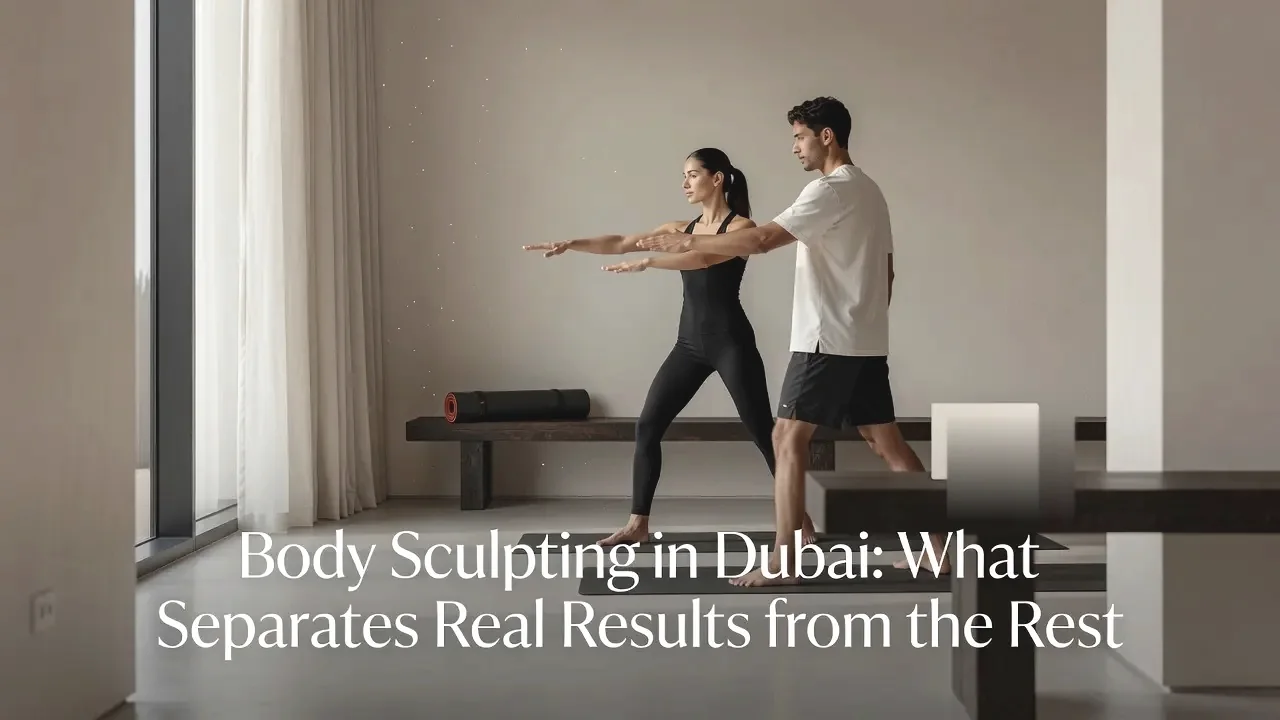
Not every body contouring clinic in Dubai delivers what it promises. With the wellness and aesthetics industry booming across the UAE, the options available to anyone looking to sculpt Dubai's competitive beauty standards can feel overwhelming, and frankly, not all of them are worth your time or money.
Whether you are considering non-invasive fat reduction, muscle-defining treatments, or a full body sculpting program, the difference between transformative results and disappointing outcomes often comes down to a handful of critical factors. Technology, technique, expertise, and aftercare all play a role that most clinics simply gloss over in their marketing.
In this post, we break down exactly what separates the clinics producing genuine, lasting results from those relying on flashy promises and outdated methods. You will come away with a clear framework for evaluating your options, understanding which treatments are backed by real science, and knowing the right questions to ask before committing to any program. If you are serious about your body transformation goals, this comparison will save you both money and frustration.
What Body Sculpting Actually Requires
Body sculpting is not a workout style, a machine, or a single training method. It is a body-composition outcome: the simultaneous reduction of excess fat and development of lean muscle tissue. That distinction matters enormously when you are evaluating options in Dubai, because a great deal of what gets marketed under the sculpting label addresses only one side of that equation, typically fat reduction, and delivers a result that is softer, weaker, and far shorter-lived than the client expected.
Achieving genuine body composition change requires three interlocking inputs working together at the same time. The first is progressive resistance training, structured so that the muscles face increasing mechanical demand week over week. The second is calibrated nutrition, meaning a protein-forward approach with a calorie deficit or surplus dialled to your specific phase and goal. The third is consistent recovery: quality sleep, managed stress, and structured rest that allows the adaptation from training to actually occur. Most programs fail not because of a single missing ingredient but because they deliver one or two pillars while neglecting the third. Remove any one leg and the system collapses.
The motivation driving sculpting clients in 2026 has also shifted. According to NASM's survey of 625 fitness professionals, longevity and healthy aging have overtaken traditional physique goals as the fastest-growing client motivation. Today's clients want durable energy, functional capacity, and long-term health alongside visible aesthetics. A program framed purely around appearance is already misaligned with where the market has moved.
There is one more structural factor that any serious comparison must account for: GLP-1 weight-loss medications. Approximately 1 in 8 adults now reports using weight-loss medication, and NASM's guidance on supporting clients through their GLP-1 journey is direct on the risk. These drugs suppress appetite and reduce total calorie intake, which accelerates muscle-mass loss during the weight-loss phase. Without protein-forward nutrition and structured resistance training running in parallel, a significant portion of the weight lost will come from muscle rather than fat, undermining the sculpted outcome entirely.
This three-pillar framework is the most useful filter you can apply when comparing providers. Any option that cannot address training, nutrition, and recovery together will produce results that are limited in scope and temporary in duration.
How to Evaluate Your Options in Dubai
Dubai's fitness market is one of the most saturated in the region. Independent trainers, boutique studios, and online programs compete for the same client base, and almost all of them use identical language: sculpt, define, transform, tone. When every provider sounds the same, surface-level comparison becomes genuinely unreliable. According to Trainerize's 2026 industry report, four in five personal trainers globally say that acquiring new clients is now harder or has plateaued. In a market where supply has outpaced demand, the credential gap between the best and worst providers widens while remaining largely undisclosed to the consumer making the decision.
REPs UAE is the regulated registration body for fitness professionals operating legally in the UAE, and the organization actively campaigns under the hashtag #isyourtrainerregistered precisely because unregistered practitioners remain a live concern. REPs licensure is the legal floor, not a quality ceiling. What sits above it matters considerably more: specialist qualifications, nutrition credentials, continued professional development, and structured program design. CPD certification courses that renew REPs UAE licensure confirm that the standards bar is actively rising, making ongoing investment in education a meaningful differentiator between providers.
When evaluating any sculpting program in Dubai, five criteria separate credible options from credible-sounding ones. First, verify coach licensure and whether credentials extend beyond the base registration. Second, confirm whether nutrition guidance is integrated by the same qualified coach or simply absent. Third, assess scheduling and access flexibility against your actual working pattern. Fourth, examine whether the program has a defined structure and measurable progression. Fifth, consider whether the delivery format suits your need for privacy and consistency of coach attention.
Boutique studio formats offer real community value, but they introduce trade-offs that do not suit every client. Shared coach attention, fixed class schedules, and a semi-public environment create friction for professionals with unpredictable calendars or a preference for discretion. For clients who need one coach, one standard, and a session that fits around their day rather than the other way around, the boutique model is structurally misaligned with those requirements.
Mobile Private PT vs Boutique Studio vs Freelance Trainer
Three distinct delivery models serve Dubai's fitness market, and they are not interchangeable. Understanding the structural differences between them is the clearest way to predict which one will actually produce the sculpting results you are after.
Boutique Studios
Boutique studios offer genuine strengths: consistent class programming, a defined training culture, and a community atmosphere that larger commercial gyms rarely replicate. For clients whose primary goal is general fitness or group motivation, that environment works well. For body-composition and sculpting goals, however, the format introduces friction. Sessions are group or semi-private, meaning coaching attention is divided. Instructors rotate across the timetable, so the coach who assessed your movement in week one may not be present in week four. Scheduling is fixed to the studio's calendar, not yours, and a missed window is simply a missed session. Most critically, nutrition guidance sits entirely outside the service. Since sculpting depends as much on what you eat as how you train, leaving that variable unmanaged places the majority of your result in your own hands, unsupported.
Freelance Independent Trainers
Independent trainers offer scheduling flexibility and, typically, a lower entry price point. The trade-off is meaningful. In an open market like Dubai's, finding a verified PT can be genuinely difficult; credential quality varies widely and verification is the client's responsibility. Nutrition integration is rarely included. Program structure tends to be informal and session-by-session rather than periodised across a training block. Accountability beyond the individual trainer's own professionalism is largely absent. When the coach changes or cancels, the system stalls.
Mobile Private PT
The mobile model inverts the inconvenience equation entirely. The coach travels to your home, building gym, or preferred outdoor space. Sessions are fully one-to-one with a single named coach throughout the engagement, which means load progression is tracked across every session, not reset by a rotating face. Scheduling adapts to your week. Privacy is a structural feature of the model, not an optional upgrade, which matters significantly for clients who prefer discreet sessions away from a public floor.
For sculpting specifically, this format carries a compounding program advantage. The freelance vs. gym-staff distinction often comes down to structure and accountability; mobile private PT resolves both. Form correction is continuous, not periodic. Every variable is managed, including nutrition, which group and freelance formats leave unaddressed.
The global wellness market has reached $2 trillion annually (McKinsey, cited in Telomere Consulting 2026). In a high-income market like Dubai, the spend decision is already made. The question is which format earns it by delivering a complete, accountable system rather than one component of the result.
The Nutrition Gap: Why Most Sculpting Programs Fall Short
Visible physique change is, at its core, a nutrition outcome. Training produces strength, cardiovascular capacity, and muscular development, but without a matched eating strategy, the body-composition shift most sculpting clients are seeking rarely materialises. Research into lean muscle definition confirms that dialling in protein targets, caloric staging, and macronutrient distribution is what separates someone who trains consistently from someone who actually sees measurable definition. The session is the stimulus; the nutrition is where the result is built or lost.
The problem is structural. Across most personal training services in Dubai, nutrition exists as verbal commentary at best: general guidance to eat more protein, avoid processed food, or stay in a deficit. That is not a plan. A credible nutrition program is built against the client's actual training volume, body metrics, and measurable goals. It specifies daily protein, carbohydrate, and fat targets. It adjusts as the client's body responds. It is reviewed by someone qualified to review it. Without that architecture, clients fall into the gap between training hard and seeing results.
SHUYO Fuel closes that gap directly. Coach-reviewed meal plans are built to each client's specific numbers, prepared fresh, and delivered to the door in Dubai. Nutrition is not an optional add-on to the program; it is a core component, connected to the same training data and reviewed by the same qualified coach who writes the sessions.
This integration becomes clinically important for clients on GLP-1 medications such as semaglutide or tirzepatide. Published research confirms that lean mass and musculoskeletal preservation during GLP-1-based weight loss requires active management across nutrition, exercise, and monitoring strategies. Approximately 25 to 40 percent of weight lost during medically induced weight loss can come from lean tissue, including skeletal muscle. Hitting adequate protein targets under significant appetite suppression takes deliberate, structured effort, and micronutrient density must be maintained alongside caloric staging to prevent degradation of lean mass. A trainer who is not also a qualified nutrition coach cannot manage this effectively; the two disciplines must operate as one.
When evaluating any sculpting provider in Dubai, ask three direct questions: who designs the nutrition plan, what qualification do they hold, and how does the plan connect to the training program? A certified nutrition coach reviewing plans against live training data is a meaningfully different standard from a PT offering broad dietary tips after a session. Vague or deflected answers to those three questions reliably signal the gap described above, and for clients investing seriously in a sculpting outcome, that gap has a real cost.
Privacy, Scheduling, and the Female Client Advantage
For many women in Dubai, the question of where to train is not simply a matter of preference. It is a practical constraint. Those who prefer culturally discreet sessions, those returning to exercise after childbirth, and those managing the unpredictable energy and physical changes of perimenopause or menopause are navigating a fitness market that has not yet built sufficient private, qualified supply to meet their needs. A public gym floor or a mixed boutique class is not a neutral environment for these clients; it is an active barrier. NASM's 2026 specialist framework acknowledges this directly, listing women's life-stage training among its most actively promoted and fastest-growing PT specialisations. Institutional recognition of the specialization now exists. The gap is in delivery: coaches who are appropriately qualified, and environments that make showing up feel safe and sustainable.
A mobile, at-home model addresses that gap structurally. Removing the commute eliminates the first point of resistance. Removing the gym floor eliminates the social visibility of training. Removing the need to change, arrive, and be seen in a public space eliminates the friction that, for this specific client profile, is often the difference between consistent training and repeated cancellation. This is not a minor convenience upgrade. It is the condition that makes the program viable in the first place. SHUYO's mobile model means the coach comes to you, whether at home, in your building gym, or outdoors, at a time that works within your week rather than around a fixed class grid.
Scheduling flexibility carries equal weight for executives and professionals whose calendars shift week to week. A class-based model, which requires booking a slot several days in advance and issues cancellation penalties when plans change, is structurally incompatible with senior professional life. Each missed session becomes a financial loss and a motivational setback. A mobile PT structure with adaptive scheduling converts that friction into a rescheduled session, not a broken streak.
SHUYO's three-tier structure, The Practice, The Method, and The Mastery, each running at three sessions per week, maps directly to how the market increasingly wants to purchase fitness services. Tiered recurring plans are now the dominant model across fitness operators globally, and SHUYO's structure delivers that predictability without sacrificing the scheduling flexibility that makes mobile PT worth choosing in the first place.
Data, Credentials, and the One-Coach Standard
Nearly half of adults now own a fitness tracker or smartwatch, and according to Everfit's 2026 personal training trends report, clients increasingly expect their coach to actively incorporate that data into program design. Generic programming built on population averages rather than individual metrics is no longer an acceptable standard. When a client can open their wrist and see resting heart rate trends, sleep quality scores, and activity load, a coach who ignores that information is working with less information than the client already holds.
A Data Baseline Before Session One
SHUYO addresses this directly through the SHUYO Score assessment and Know Your Numbers calculators, both completed before any training begins. Body composition, movement quality, and key health numbers are benchmarked at the outset, giving the program a factual foundation rather than an estimated one. Progress is then tracked against those opening numbers, not against a subjective impression of how sessions are going. This approach aligns with the direction REPs UAE has described as the professional standard for 2026: coaches who can read, interpret, and act on client data rather than rely on effort alone.
One Credential Set, Zero Handoffs
Abdul Wahid holds REPs Dubai licensure alongside a certified nutrition and wellness coaching credential. Both training design and nutritional guidance sit within the same qualified professional, which removes the structural problem common to multi-service setups: a PT and a separate, unconnected nutritionist operating from different data sets and different assumptions. The person who writes the program delivers every session and reviews every week of nutrition. There is no departmental boundary, no communication gap, and no diluted accountability.
McKinsey's 2026 wellness research notes that close to half of consumers now treat wellness as a top daily priority. At that level of personal investment, who delivers the coaching is not a secondary consideration. Consistency of contact, continuity of knowledge, and a single professional standard across training and nutrition are what convert that daily commitment into measurable results.
Consistency Over Transformation: The Shugyo Principle
The word shugyo (修行) translates from Japanese as disciplined self-mastery cultivated through daily practice rather than isolated bursts of effort. It is not a fitness trend. It is a philosophy of how lasting change is actually built, and it is the foundation on which SHUYO was designed. In an industry that has long sold 6-week transformations and rapid-results programs, the Shugyo principle runs in the opposite direction: the system must do the work that willpower cannot sustain.
That position is no longer contrarian. Trainerize's 2026 fitness trends report identifies habit-based and behavior coaching as gaining significant ground over program-switching, and the data supporting this shift is unambiguous. Research consistently shows that a mediocre program a client can sustain for six months will always outperform the optimal program they abandon in two weeks. Clients who build daily practice produce more durable results than those who rotate through transformation cycles, because transformation is not the input. It is the output of months of compounding consistency.
The practical implication for body sculpting is specific and often misrepresented. Visible physique change is a lagging indicator: it reflects weeks and months of calibrated training, matched nutrition, and managed recovery that accumulated long before the mirror confirmed it. Any program that promises rapid physical change without engineering those upstream habits is, in effect, selling the lag without the lead. Approximately 80% of fitness resolutions are abandoned by mid-February, and this is framed by behavior researchers not as a failure of character but as a failure of design. The system was not built to hold.
This is precisely the problem SHUYO's The Circle community is designed to solve. The Circle provides the accountability layer that keeps consistency intact between sessions, not by generating motivation (which is situational and unreliable) but through structure, shared practice, and ongoing coach visibility. Habit-based routines succeed because they reduce decision fatigue, protect consistency during disrupted weeks, and make progress predictable across months. The Circle operationalises exactly that: a floor of practice maintained by community and coach, not by mood.
For ambitious professionals in Dubai, whose schedules are non-linear and whose cognitive reserves are depleted well before the evening, this is not a supplementary feature. A system that manages consistency on their behalf, rather than demanding they generate it from scratch after a full day of high-stakes decisions, is the defining characteristic of a program that will actually run. The Shugyo principle, practically applied, means the client does not need to rely on willpower. They need a structure that makes showing up the default. That is what SHUYO builds.
How to Start Your Sculpting Program in Dubai
Before committing to any sculpting program in Dubai, verify three non-negotiable fundamentals. First, confirm the coach holds a REPs Dubai license; this is the regulatory standard for personal trainers in the UAE and your primary protection against unaccredited freelancers. Second, confirm that nutrition is genuinely integrated into the offering, not simply mentioned as an add-on. Third, assess whether the delivery model fits your actual schedule and privacy preferences, not the schedule a studio or clinic dictates to you.
Every SHUYO journey begins with a free 60-minute trial assessment. This is not a sales call. It is a working session with Abdul Wahid covering movement quality, body composition, training history, and goal framing. You leave with a clear, documented baseline before any financial commitment is made. That distinction matters in a market where free consultations are commonplace but rarely produce anything actionable.
Location is not a constraint. SHUYO serves clients across Marina, JBR, Downtown, Business Bay, Palm Jumeirah, JVC, Dubai Hills, Arabian Ranches, Jumeirah, and Emirates Hills, as well as Sharjah and Abu Dhabi. Online coaching is available for clients where travel is a practical limitation, keeping the program intact regardless of circumstance.
SHUYO Fuel meal delivery can be added at any stage of the program. Abdul Wahid reviews every plan against your live training load, ensuring your nutrition is calibrated to what your body is actually doing each week. It is the most direct way to close the nutrition gap without requiring you to develop specialist knowledge yourself.
To book your free trial assessment, contact SHUYO at hello@shuyo.ae, via WhatsApp on +971 56 548 8814, or through Instagram at @weareshuyo.
The Standard Worth Choosing
Sculpting results in Dubai are available from many providers. The differentiator is never the equipment, the location, or the marketing claim. It is the completeness and consistency of the system behind the result. A credible sculpting program in 2026 requires four non-negotiables: a coach who is both licensed and nutrition-qualified, a delivery model that fits your schedule and respects your privacy, integrated meal planning that removes the execution gap between knowing and doing, and a program structure built for months of progressive practice rather than weeks of effort.
SHUYO addresses every one of these criteria inside a single offering. Abdul Wahid holds both a REPs Dubai personal training license and nutrition and wellness coaching credentials, combining what most providers split across two separate practitioners. The mobile model brings sessions to your home, building gym, or outdoor space across Dubai, eliminating the commute and the crowded floor. SHUYO Fuel delivers coach-reviewed meal plans, fresh and calibrated to your numbers, directly to your door. The Circle provides the accountability structure that sustains practice long after motivation fluctuates.
The free 60-minute trial assessment removes the risk from the first step entirely. Use it to establish your baseline numbers, test the coaching model in your own environment, and make a decision from information rather than assumption.
Practice daily. Master yourself.
Conclusion
Choosing the right body sculpting clinic in Dubai does not have to feel like a gamble. The clinics delivering real, lasting results share a few non-negotiable qualities: clinically proven technology, qualified practitioners, personalized treatment plans, and genuine aftercare support. Flashy marketing and discounted packages are rarely substitutes for these fundamentals.
Before you book your next consultation, revisit the framework covered in this post. Ask the hard questions, request evidence, and trust your instincts when something feels misaligned with your goals.
Your body deserves investment backed by science, not just aesthetics trends. Take the insights from this guide, apply them to your search, and you will be far better positioned to find a clinic that delivers exactly what it promises. The results you want are achievable; you simply need the right team to help you get there.