What to Look for in a Personal Trainer in the UAE
Credentials, delivery model, nutrition scope and how a coach communicates. The four filters that matter across the UAE.
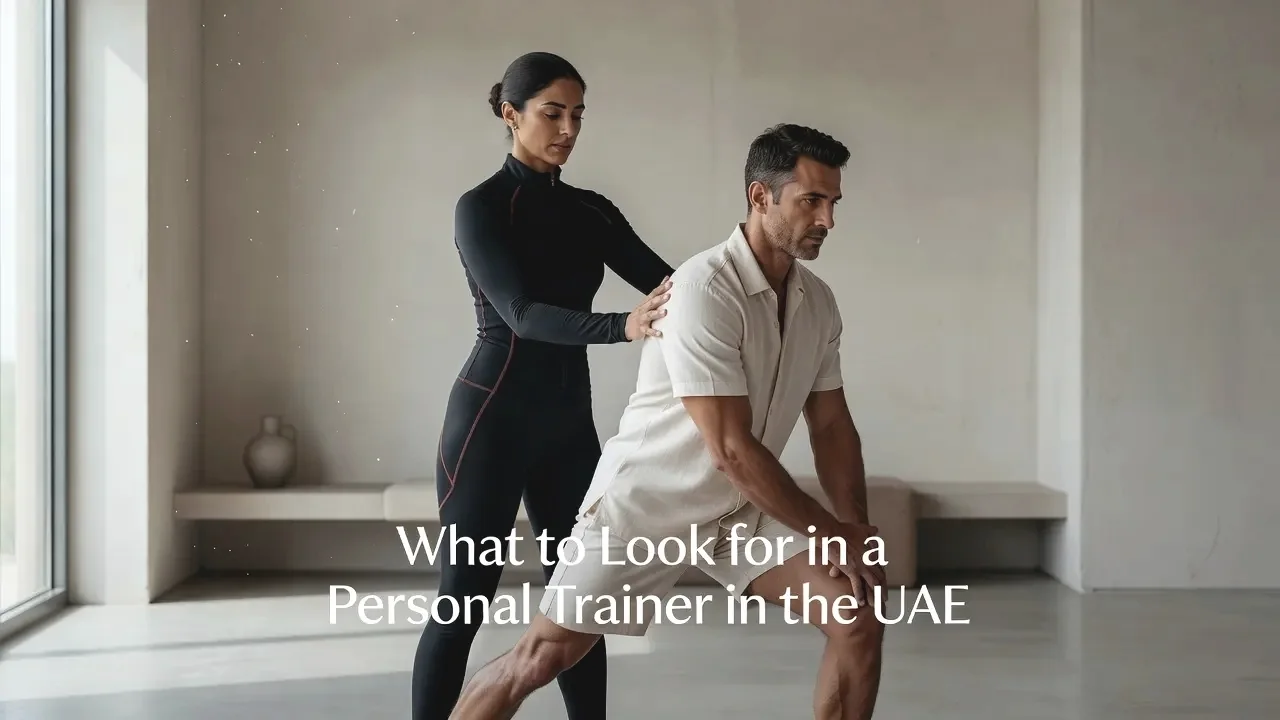
Finding the right personal trainer in the UAE can feel overwhelming, especially when you are just starting your fitness journey. With hundreds of certified coaches scattered across Dubai, Abu Dhabi, and beyond, knowing who to trust with your health and goals is not always straightforward.
The fitness industry in this region is booming, and that growth brings both exceptional talent and, unfortunately, underqualified individuals who promise fast results without the knowledge to back it up. As a beginner, you deserve a trainer who not only understands exercise science but also knows how to guide someone with little to no experience safely and effectively.
This guide breaks down exactly what you should look for before signing up with any personal trainer UAE residents are choosing today. From verified qualifications and communication style to cultural compatibility and pricing transparency, we cover the key factors that separate a truly great trainer from one who will waste your time and money. By the end, you will feel confident and informed enough to make the right choice for your fitness future.
Why Finding the Right Personal Trainer in the UAE Is Different
Hiring a personal trainer anywhere requires thought. Hiring one in the UAE requires a different kind of thinking altogether. The structural realities of life in Dubai, from its climate to its work culture to its residential architecture, create conditions that simply do not exist in most other cities. Understanding these conditions is the first step toward making a smart choice.
The heat changes everything. Dubai's summer temperatures frequently exceed 45°C from June through September, making sustained outdoor training not just uncomfortable but genuinely dangerous. Heat exhaustion and heat stroke are real risks at these temperatures. This means any trainer who builds their entire practice around outdoor sessions is, for roughly four months of the year, offering you an incomplete or unsafe service. A serious personal trainer in the UAE must be able to deliver effective programming across multiple environments, including your home, your building gym, and climate-controlled spaces.
Time is the real currency in Dubai. Research consistently shows that Dubai professionals work among the longest hours in the world, often logging 55 to 60 hours per week. Adding a 40-minute commute to a commercial gym on top of a training session is not a minor inconvenience; it is a structural barrier that causes most gym memberships to go unused within weeks. Mobile, at-home coaching removes this friction entirely. The session comes to you, which means the only decision you need to make is whether to show up, not whether the drive is worth it.
The expat factor creates a specific challenge for newcomers. The UAE's population is predominantly expatriate, and that population rotates continuously as residents arrive, settle, and move on. If you have recently relocated, you are navigating a fitness market with no local reference points. You may not know which certifications are credible, what licensing standards apply, or what a quality coaching relationship should feel like. Communities of Dubai expats highlight this uncertainty regularly, with residents noting that the market is dense with options but uneven in quality. Credentials from internationally recognized bodies such as NASM remain the clearest quality signal available to newcomers evaluating trainers they have never met.
Your building gym is probably better than you think. Most Dubai apartment towers include a gym as a standard amenity. The majority of these spaces sit underused, not because the equipment is inadequate, but because no one has ever programmed them properly. A well-prepared at-home trainer, carrying resistance bands, a TRX, and a structured plan, can turn a building gym with a few dumbbells and a cable machine into a fully functional training environment. Residents who assume they need a large commercial gym to train effectively are often surprised by what is achievable within their own building.
Private coaching is no longer a luxury category. The global personal fitness trainer market is valued at USD 48.0 billion in 2026 and projected to reach USD 80.5 billion by 2036. In-person training holds a 60% share of that market. These numbers reflect a broader cultural shift; private coaching has moved from a discretionary expense into a standard investment that professionals make in their own performance and longevity. In a city like Dubai, where the cost of losing physical and mental capacity is high, this shift makes particular sense.
REPs Dubai Certification: The Credential That Actually Matters
When you begin searching for a personal trainer in the UAE, one credential separates professionals who are legally operating to a verified standard from everyone else: REPs UAE registration. The Register of Exercise Professionals is the official licensing body for fitness professionals in the UAE, and its own messaging is direct about what registration means. It is not simply a badge. It is a verified commitment to professionalism, recognized qualifications, and ongoing accountability. Working with a trainer who cannot produce a current REPs UAE license number is a meaningful risk, both in terms of the quality of training you receive and the absence of any professional framework holding that person accountable if something goes wrong.
What REPs Registration Actually Requires
A REPs UAE license is not something a trainer earns once and retains indefinitely. Registration requires holding qualifications approved by the REPs UAE accreditation list, completing Continuing Professional Development on an ongoing basis, and renewing the license on a regular cycle. CPD courses carry specific point values within the system, and renewal is a fixed professional obligation rather than an optional upgrade. This structure matters because it means a currently licensed trainer is demonstrably active in their professional development, not simply coasting on a certificate earned years ago.
Why Overseas Certificates Are Not Enough
Many trainers working in the UAE hold qualifications from overseas academies that are not recognized by REPs UAE. An internationally issued certificate may look credible on a profile, but if it does not appear on the REPs UAE approved qualifications list, it does not satisfy the UAE standard. Before committing to any trainer, ask directly for their current REPs UAE license number. The #isyourtrainerregistered campaign running actively in 2026 exists precisely because this verification step is still being overlooked by clients across the UAE.
The Standard Beyond the Legal Baseline
REPs certification tells you something that a certificate alone cannot. It confirms the trainer has been assessed against a professional framework with practical components, not simply completed a self-paced online course or a short weekend program with no applied evaluation. The register covers distinct categories: a trainer holding Category A (Personal Trainer) has been vetted specifically for that role.
One additional differentiator worth weighing is whether the trainer holds a nutrition coaching certification alongside their REPs license. Research consistently shows that clients increasingly prefer a single qualified expert managing both their training and their diet, rather than coordinating between separate professionals. When one coach holds both credentials, the program operates as an integrated system. At SHUYO, founder Abdul Wahid carries both his REPs Dubai license and a certified nutrition and wellness coaching qualification, which means every client works within a framework where training and nutrition are designed together from the first session.
Mobile, Gym, or Online: Choosing the Format That Fits Your Life
Once you have verified a trainer's credentials, the next decision is structural: which format of coaching will actually work for your life? The answer matters more than most beginners expect, because the right format removes friction, while the wrong one quietly becomes the reason you stop.
The data is clear on one point. In-person training holds a 60% share of the global personal fitness trainer market in 2026, in a market now valued at USD 48.0 billion. Despite years of growth in app-based and digital alternatives, face-to-face coaching remains the dominant format by a wide margin. The reason is straightforward: a physically present coach can correct your form in real time, read how your body is responding to load, and create the kind of accountability that an algorithm cannot replicate.
At-home personal training is a subcategory of in-person coaching, and for Dubai residents, it is often the most practical one. The model is simple: the trainer comes to you, whether that means your apartment, your building gym, or a nearby outdoor space. What this removes is the commute, which in Dubai can consume 30 to 45 minutes per round trip depending on your location and the time of day. That time cost, compounded across weeks, is the single most common reason programs stall. When the session comes to you, the only variable you control is showing up.
Commercial gym-based training suits people who genuinely enjoy a gym environment and have a facility within easy reach of home or work. The honest caveat is that a gym introduces variables outside the trainer's control: peak-hour floor congestion, unavailable equipment, and the cognitive overhead of travel. None of these are fatal to progress, but each one adds a small reason to reschedule.
Online-only coaching offers flexibility and is typically lower in cost. For beginners, however, it carries a real limitation. Without a coach physically present, form correction relies on camera angles, self-reported feedback, and written cues. Physical coaching involves tactile correction and spatial awareness that a video call cannot replicate. For someone new to training, this gap matters.
Hybrid coaching has become the expected baseline in 2026. According to industry trend data, the strongest coaching relationships now combine regular in-person sessions with digital check-ins, programming updates, and nutrition tracking between appointments. This is not a premium feature; it is simply how effective coaching operates at scale.
For residents across Dubai Marina, Palm Jumeirah, Business Bay, JVC, Dubai Hills, and Arabian Ranches, the most practical solution is a at-home trainer who already operates across those neighborhoods. Coordination friction, the small logistical weight of scheduling around traffic, parking, and gym access, is what causes good intentions to become inconsistent attendance. Remove the friction, and consistency becomes structural rather than motivational.
Why One Consistent Coach Beats a Rota System
Many gym chains and franchise personal training services operate on a simple logic: a session is a session, and any qualified trainer can deliver it. In practice, this means the coach who assessed you, identified your imbalances, and designed your program may rarely be the person who shows up on the floor with you. You rotate through whoever is available that day. This is a structural problem, not an occasional inconvenience.
Coaching effectiveness depends on accumulated context. A trainer who has not observed your last three sessions cannot make the micro-adjustments in load, form, and intensity that actually drive progress. They cannot recognize that your left shoulder has been compensating under fatigue, that your squat depth has improved and needs a new stimulus, or that you are carrying work stress this week and need a different session register entirely. These are not small details. They are the mechanism by which training produces results rather than just effort. Research published in Heliyon (2024) confirms that the measurable advantage of personal trainer guidance over other exercise arrangements depends precisely on the trainer's active, ongoing observation of the individual.
The 2026 personal training landscape has made the business signal clear. Retention-first coaching businesses, those that invest in client experience and continuity rather than constant new-client acquisition, are the ones producing better outcomes and stronger client relationships. When you are evaluating a trainer or a service, the way they think about continuity tells you everything about how they think about your results.
A founder-led, one-coach model changes the accountability structure entirely. Your trainer has a direct professional stake in your progress, not a shift-completion incentive. If results plateau, there is no diffusion of responsibility across a rota. One person is responsible, and that person is in the room with you. Industry analysis on what clients genuinely value consistently confirms that clients prioritize a trainer who truly cares about their results, and that relational continuity is the structural requirement for delivering exactly that.
When you speak to any personal trainer in the UAE, ask one direct question before anything else: will the same coach deliver every single session? If the answer involves qualifications, shift arrangements, or phrases like "usually" or "most of the time," treat that as meaningful information. Consistency is not a preference. It is the product.
A Defined Coaching Philosophy Is a Signal, Not a Marketing Line
Most personal trainers in the UAE compete on three surface signals: price, schedule availability, and proximity to your building. These are practical considerations, but they tell you almost nothing about whether a trainer can actually deliver consistent, lasting results for a busy professional. A coaching philosophy, by contrast, is the underlying logic that explains why a trainer structures sessions the way they do, how they sequence progression, and what they prioritize when real life gets in the way. It is a rare quality. The majority of trainers operating in Dubai can tell you their rate and their available slots before they can tell you their methodology.
This gap matters most during the hard weeks, not the easy ones. Every training journey includes missed sessions, travel disruption, diet slippage, and periods of low motivation. A trainer with no defined philosophy has no consistent framework for navigating those moments; generic encouragement fills the vacuum instead. For a time-poor executive or a parent managing a packed schedule in Dubai, generic motivation is not a system. It is noise. A trainer who has thought seriously about coaching will have a clear, repeatable response to disruption, one that keeps the client moving forward without demanding perfect conditions.
This is precisely why habit-based and behavior coaching has emerged as the defining trend of 2026. Clients are no longer looking for workouts that work when everything goes right. They want systems that continue functioning when things go wrong. The most effective coaching models in 2026 are designed to reduce willpower dependency by building automatic behaviors and environmental structures around health. A trainer who understands this will design your program with your actual life as the operating context, not an idealised version of it.
When you are assessing a potential trainer, listen for specific language. Terms like progressive overload, recovery integration, lifestyle alignment, and sustainable practice indicate a trainer who is thinking in months and years, not just the next session. According to 2026 fitness industry analysis, recovery is now described as a core programming variable rather than an optional add-on. A trainer who can articulate how they manage training load, rest, and habit formation together is demonstrating a philosophy, not a sales pitch.
Finally, treat dramatic before-and-after transformation content with caution. When a trainer's entire marketing presence is built around extreme physical change in short timeframes, that signals a business model built on high turnover and aesthetics-first priorities. Retention-first coaching, where the measure of success is a client still training consistently twelve months later, requires a fundamentally different philosophy. The trainers building durable client relationships in 2026 are investing in systems and client experience, not dramatic imagery designed to attract someone at a moment of peak motivation.
Training Without Nutrition Coaching Is Half a Program
The most common reason clients in Dubai plateau after weeks of consistent training has nothing to do with effort in the session. It is what happens outside it. A 2014 meta-analysis published in Obesity Reviews found that exercise-only interventions produced an average of just 2.9 kg of weight loss over 12 months, while diet-alone approaches averaged 10.7 kg over the same period. Combined programs achieved 11.4 kg. The arithmetic is unambiguous: training without nutritional structure accounts for a fraction of the result. A single restaurant meal in Dubai can exceed 1,200 calories, while a demanding HIIT session burns roughly 400 to 600. You cannot close that gap through effort alone.
The Case for a Single Expert Managing Both
When a trainer holds a recognized nutrition qualification, such as Precision Nutrition, ISSA Nutrition, or the NASM Certified Nutrition Coach credential, they are equipped to calculate your Total Daily Energy Expenditure, set calibrated protein targets, and structure macro ratios that align directly with what you are doing in training. This removes a fragmentation problem that affects a significant number of Dubai clients: receiving training advice from one professional and dietary guidance from another, where neither party has visibility of the other's recommendations. The result is contradictory information, missed synergies, and slower progress. A single coach holding both sets of competencies eliminates the coordination gap entirely.
Dubai's Specific Food Environment Requires a Practical Answer
Restaurant-heavy social culture, late working hours, and limited time for cooking are not excuses. They are structural realities of life in Dubai, and a credible coaching program accounts for them. When a trainer can connect you with coach-reviewed, freshly prepared meals calibrated to your numbers and delivered to your door, food compliance becomes a system rather than a daily act of willpower. This is precisely the model behind SHUYO Fuel, which pairs training programming with meal plans built to your targets and prepared fresh for Dubai delivery.
What to Ask Before You Commit
When evaluating any personal trainer in the UAE on their nutrition capability, ask three specific questions. First, what is their nutrition qualification and who accredited it? A trainer should be able to name the certification and the awarding body clearly. Second, how do they calculate your individual targets? The answer should reference TDEE, activity multipliers, and goal-specific adjustments, not a generic template. Third, is structured meal planning included in the program or described vaguely as general advice? These questions separate coaches who hold genuine, applied nutrition competency from those offering surface-level guidance that will not move the needle. In 2026, clients increasingly expect one trusted expert managing training and nutrition as a single integrated system, and the best coaches in Dubai are built to meet exactly that expectation.
Private Training Options for Women in the UAE
For many women in the UAE, the decision to avoid a public gym is not a preference. It is a practical and often non-negotiable requirement. Cultural norms, religious practice, personal comfort, and the reality of training in mixed-gender public spaces all create genuine barriers that standard gym-based personal training cannot resolve. A significant proportion of Dubai's female population prefers to train without a hijab or abaya, which makes a private setting a functional necessity rather than a luxury upgrade. Most gym-based PT services are structurally unable to address this, which leaves a large and underserved segment of women searching in informal channels, including social media groups, because formal options have failed to meet their needs clearly.
A personal trainer at home removes this problem at the root. When a coach comes to your home, your building gym, or your villa courtyard, the public gym dynamic disappears entirely. There is no shared floor, no unfamiliar faces, no requirement to navigate a facility on someone else's terms. The session happens in an environment you control, at a time that suits your schedule, including daytime hours that work around childcare or other responsibilities. This is not a workaround; it is simply a better structural fit for how many women in the UAE actually live.
It is worth stating clearly: private home training does not represent a reduction in coaching quality. The same professional standards apply regardless of venue. Structured programming, real-time form correction, progressive overload, and nutrition coaching all translate fully to a home or building gym setting. Women evaluating trainers for private sessions should apply the same quality filters described earlier in this guide, and then add several specific questions.
When speaking to a potential trainer, ask directly whether they have experience coaching female clients on goals specific to women's physiology. According to resources covering female personal trainer options in Dubai, relevant areas include hormonal health, bone density, posture correction, and energy management across training cycles, not just fat loss or general fitness. Ask whether nutrition coaching is included or sold separately, and confirm whether the trainer holds a certification that signals genuine competence in these areas beyond a general PT license.
The absence of comprehensive, women-focused guidance in this space is itself a market signal. Women researching personal trainers in Dubai should treat a trainer's ability to speak specifically and knowledgeably to private training for women as a direct indicator of their experience and preparation. A trainer who has worked consistently with female clients in home settings will be able to answer these questions without hesitation. One who cannot is unlikely to be the right fit, regardless of other credentials.
Corporate and Team Training: What UAE Businesses Should Know
Corporate wellness has crossed a threshold. The Global Wellness Institute's 2025 Wellness Economy Monitor values the global wellness economy at $6.8 trillion, with workplace wellness tracked as one of eleven distinct economic sectors. This is no longer a perks conversation. Employer-sponsored fitness is now a retention and performance investment that HR directors and CFOs are expected to justify with measurable outcomes.
Dubai creates a particular version of this demand. The city's concentration of regional headquarters, multinational firms, and executive populations produces a workforce operating under sustained high pressure, long hours, and compressed schedules. Requiring staff to leave the building for a midday fitness session is not realistic in this context. What works is a personal trainer who comes to the office, the company gym, or the hotel facility, at a time that fits around meetings rather than competing with them.
The distinction between a corporate personal training program and a group fitness class matters enormously. A group class offers a fixed format to a mixed audience. A professional corporate engagement should open with individual or team assessments, build programming that either scales across varying fitness levels or is individualized for specific employees, and generate reportable outcomes that a wellness manager can present against an HR KPI. Without those three components, a company is paying for activity, not results.
Executive coaching is a growing sub-segment within this space. One-to-one sessions designed around the physical and cognitive demands of senior leadership treat physical capacity as a professional asset, not a lifestyle preference. Sleep quality, stress recovery, and sustained energy across a working day are performance variables, and a well-structured program addresses all of them.
If your business is briefing a personal trainer for a corporate program, request a written proposal that specifies session formats, assessment methodology, a reporting framework, and a clear explanation of how the program accommodates employees at different starting points. SHUYO Corporate delivers exactly this model across Dubai, offering onsite sessions, executive coaching, and wellness workshops built around your team's schedule and objectives, not a generic timetable.
Accountability Structures: What Keeps You Consistent Between Sessions
A training session is two hours of your week. The remaining 166 hours determine whether that session produces a result or simply produces fatigue. What you eat between Monday and Wednesday, how well you sleep on Thursday night, how you manage a high-pressure work deadline on Friday morning, and whether you move at all on the days you are not training, these variables collectively outweigh what happens on the gym floor. This is not a motivational observation. It is a structural reality that separates clients who see measurable change from clients who train consistently and wonder why nothing shifts.
The strongest coaching businesses in 2026 have recognized this gap and built systems around it. Retention-first coaching, now identified as the defining characteristic of high-performing personal training services, means investing in the client experience across the entire week, not only during the session itself. This looks like scheduled check-in messages, weekly progress tracking against agreed metrics, nutrition accountability, and consistent communication that keeps a client oriented toward their goals even when the coach is not physically present. A trainer who delivers excellent sessions but goes silent between them is offering half a service.
Community structures amplify this further. An accountability group or members community attached to a coaching program provides social reinforcement that individual willpower simply cannot replicate, particularly for clients whose professional lives in Dubai are already high-stress and time-compressed. Knowing that others are tracking the same habits, facing the same resistance, and reporting back creates a layer of external structure that makes consistency far less dependent on motivation.
Wearable data integration is a meaningful differentiator in this context. Nearly 50% of adults now own a fitness tracker or smartwatch, and the data these devices generate, covering sleep quality, heart rate variability, resting heart rate trends, tells a coherent story about recovery and readiness. A coach who can read and respond to that data makes better programming decisions than one who ignores it entirely.
When evaluating any personal trainer in the UAE, ask directly: what does between-session support look like? How is progress tracked week to week? Is there a community or accountability structure in place? The answers will tell you whether you are buying two hours per week or a complete system. At SHUYO, The Circle provides exactly this layer, a members community built for accountability, so that consistency becomes structural rather than something you have to manufacture from willpower alone each day.
Recovery, Sleep, and Stress Are Part of the Program, Not Extras
In 2026, recovery coaching is no longer a premium tier reserved for professional athletes. Sleep quality, nervous system regulation, and stress management are baseline expectations of any serious coaching program. If a trainer you are evaluating does not address these areas, they are not offering you a complete service. They are offering you half of one.
This distinction matters more in Dubai than almost anywhere else. Professionals coaching in UAE expat communities are already bundling stress management, breathwork, and recovery protocols into their core value proposition because the market demands it. Dubai professionals routinely operate on compressed sleep, back-to-back travel schedules, and sustained cognitive stress. In this environment, inadequate recovery is not a minor variable. It is the primary factor limiting most clients' results, sitting upstream of every training adaptation they are trying to create.
What Periodising Around Life Stress Actually Means
A coach who only adjusts training load based on physical fatigue is working with incomplete information. A holistic approach means the program responds to your full stress load: a difficult quarter at work, a week of consecutive late nights, three time zones in five days. When training load is periodised against life stress, the program becomes durable. When it is not, it breaks down the moment your schedule stops cooperating, which in Dubai is frequently.
Practical recovery coaching does not require expensive wearables or diagnostic panels. It requires a coach who can teach you sleep hygiene principles, guide you through parasympathetic recovery strategies, structure active recovery sessions appropriately, and help you read your own body's signals. These are coaching skills, not technology features.
The Question to Ask Before You Hire
Ask any trainer you are considering a direct question: how do you adjust the program when a client is traveling, sleep-deprived, or under elevated work pressure? A confident, specific answer reveals genuine competence. A vague answer about "listening to the body" reveals a gap. At SHUYO, this kind of load management is built into every plan from the first session, because your results depend on it.
The Questions to Ask Before You Commit to Any Personal Trainer in the UAE
Everything covered in earlier sections builds toward one practical moment: the conversation you have with a trainer before you sign anything. Asking the right questions is not an act of distrust. It is the most efficient filter you have.
1. Are you REPs Dubai licensed, and can you share your current license number?
This is the first question, and it is non-negotiable. REPs UAE is the recognized regulatory body for exercise professionals in the UAE, and registration confirms that a trainer meets a verified competency standard. Ask for the license number directly. A professional who deflects, hedges, or cannot produce it immediately should not be hired. There is no polite way to frame an exception to this rule.
2. Will the same coach deliver every session, or am I assigned to whoever is available?
Coach consistency is a quality standard, not a luxury tier. Your progress depends on someone who knows your movement patterns, your history, and your weak points. A rota system, where any available trainer covers your slot, resets that knowledge every time it rotates. Confirm explicitly that you will train with one coach, every session.
- 3. Do you hold a separate nutrition qualification, and is nutrition coaching included in your service or charged separately?
A personal training certificate and a nutrition qualification are distinct credentials. Ask both questions. Knowing whether nutrition support is included upfront prevents unexpected costs later and tells you whether the coach is equipped to address the full picture.
- 4. How do you support clients between sessions, and what does your accountability structure look like beyond the workout itself?
Two or three sessions per week leave more than 160 hours unmanaged. Ask what exists to support those hours: check-ins, progress reviews, programming adjustments, community access. Coaching without an accountability structure is supervised exercise. The two are not the same.
5. Can you describe your coaching philosophy in two or three sentences?
A trainer who cannot answer this question clearly is operating without a system. You will feel that absence within the first month, when sessions begin to feel repetitive or directionless. A defined philosophy indicates intentional methodology, which is the foundation of consistent results.
6. Do you offer a trial session or assessment before I commit to a program?
Never commit financially before experiencing the coaching approach firsthand. SHUYO, for example, offers a free 60-minute trial assessment so both coach and client can evaluate whether the fit is right before any program begins. This protects your investment and gives you a concrete reference point against which to compare every other conversation you have.
The Right Personal Trainer in the UAE Changes More Than Your Fitness
Every criterion covered in this guide, from verified REPs UAE registration and one consistent coach to integrated nutrition, a defined philosophy, between-session accountability, and recovery awareness, forms a practical checklist you can apply to any personal training service in the UAE. No single factor alone is sufficient. A licensed trainer without a coherent philosophy will still produce inconsistent results. A philosophically aligned coach without nutrition integration will still leave half your program unaddressed. The full checklist is the standard.
A trainer who meets all of these criteria is not simply delivering sessions. They are managing a system designed to produce consistent outcomes regardless of how demanding your week becomes. Travel, late meetings, disrupted sleep, and high stress are not exceptions to life in Dubai; they are the norm. The right coach builds a program that absorbs those disruptions rather than collapsing under them.
Fitness coaching has also shifted from a discretionary luxury to a recognized staple investment for professionals who manage their health with the same seriousness they apply to other priorities. The question is no longer whether a personal trainer in the UAE is worth it. The question is how to identify the right one for your specific circumstances, schedule, and goals.
The lowest-friction starting point is a structured assessment with no obligation to proceed. SHUYO offers a free 60-minute trial assessment in which founder and REPs Dubai-licensed coach Abdul Wahid reviews your current state, clarifies your goals, and outlines what a realistic program looks like for your life. Reach out at hello@shuyo.ae or via WhatsApp at +971 56 548 8814 to book yours.
Conclusion
Finding the right personal trainer in the UAE comes down to a few non-negotiables: verified qualifications, clear communication, cultural compatibility, and honest pricing. These factors separate coaches who genuinely transform lives from those who simply take your money and deliver empty promises.
As a beginner, you have every right to ask questions, request credentials, and take your time before committing. The best trainers will welcome that process because they are confident in what they offer.
Your health is not something to gamble on. Use the guidance in this post to evaluate your options carefully, schedule consultations with at least two or three trainers, and trust your instincts alongside the facts.
The right trainer is out there waiting to meet you. Take the first step today, and invest in a partnership that will genuinely change how you look, feel, and move.